Oaks / Forest

The last few months have been full of learning and growth. 

The learning of the past days has come from trying to think like a forest, to acknowledge that even though I may take on the identity of a tree I am still embedded in a web of flows, interaction and interdependence.  I am both tree and forest.
There is a seasonality to these thoughts too. Now is not the right time to let the sap rise to burst new bud leaf spring green but time to strengthen my roots.  Let me be slow, to grow in small quiet ways. 

Blue stockings and Hope Armour.

This is not the November 9 World I wanted to wake up to. I’m wearing blue stockings in honour of yet another smart woman who lost out to misogyny (amongst other things) and as a symbol of the hope I have for a better world and a system that improves for everyone.  

Even though we might be driven by anger and disappointment I feel that we must be good and gentle as we go into this fight. We need new kinds of globally regenerative resistance (aka permaculture) and fancy new armour.


Hope Armour

The other day

I thought I’d lost my hope armour. 
See

I’d been looking for something 

armour-shaped,

but a little dull, grey

and of

heavy

metal.
It turns out that I’d sent it to be upgraded:
The armour was polished

articulated

so that I will be flexible

and my words

direct and clear.
The inside has been lined with 

(non-mulesed)

merino.

I feel caressed

insulated

yet breathable

and even after a summer’s day resistance

I will not stink.
My upgrade came with a cape

that i will embroider

with our stories

and a newly-honed hope axe

for breaking down barriers.
Heavy metal is good for rage

but not always so good for hope.

So my shield broadcasts a mix of tunes

for optimised good times.
My hope armour feels as good as new

and as it is cold out I will wear it with 

bright

blue

leggings. 
We’re taking orders for new hopes

and you can always get existing models upgraded.
The new hope is loving

and fierce

and flexible.
On trying to do better

Earth Care, People Care, Fair Share
These are the permaculture ethics, ways to live. Every day I try to be better with them, to consciously apply them to decision making and my interactions with the world.
When I follow the guidance of the ethics life feels better, it’s like there’s something sunny and rosy and a little bit exciting. It feels like hope.
A lot of the time these ethics are really hard to maintain: easier, cheaper and more sparkly options are presented, other people are difficult to engage with and the world just feels full of horribleness.
You know what? That’s ok. You acknowledge that you are always going to be learning and you try again tomorrow.
Maybe these aren’t your ethics, but they are mine and I’ll let you borrow them for a while. Take a moment with the words, place them in your mouth, lay them on your eyes, hold them to your ear.
Things will be different.

On storing wood

Venie Holmgren, the poet and mother of David Holmgren passed away recently. Together with his son and a friend, David made her coffin out of saved and salvaged wood, each piece with a memory and meaning. And then it was covered with poems.

I read somewhere that you can’t learn gardening from philosophy, but you can learn philosophy from gardening.

So, this “permaculture” with which I am so enraptured?

It is not just about gardening or sector analysis and zones. It is not just about ethics and principles and patterns and learning from ecosystems.

It is about a way of being: consciously assembling and creating the worlds we want to live in and at the same time collecting meaning and crafting it together so that the systems and objects we create are beautiful and are read as stories.

Let’s begin.

More Yellow

For some reason I love the colour yellow at the moment. I’m buying and scavenging and dying all the things yellow. Well, that is all the things that aren’t already teal, red, grey or blue.

When I was growing up my mum had a biscuit tin that was filled with onion skins. She had been saving them for years in order to use them as a dye. As far as I know the onion skin collection is still there.

Obviously these things run in the family as for the last 5 years I’ve been collecting brown onion skins in a tin. It takes a very, very long time to save 100g of onion skins.

Finally the time was right – not only was my tin of onion skins full, but tidying up my yarn stash revealed a skein of off-white Finnish wool that my parents-in-law gave me after our travels coincided in Helsinki back in 2013.

I followed a couple of blogs‘ advice about onion skin dying.

It was a three day process! I mordanted the wool with alum (boiled and then cooled) to make the fibre more receptive to the colour. I boiled, cooled and strained the onion skins. Then once again I boiled the wool in the dye, then cooled it off and rinsed the now yellow wool. There was still a lot of colour in the onion skin pot, so I dyed a pale pink linen tshirt that I’d bought with the intention of dying and threw in some grey linen scraps too. I then added another piece of white linen that I’d previously dyed bright yellow with Procion MX. After all those years of saving onion skins and the days of boiling and cooling there was no way I was going to pour the remaining dyed down the sink after 100g of wool.

In the picture below you can also see a poly-cotton bedsheet and another piece of scrap linen that I dyed with Procion MX earlier in the week.

I loved the anticipation and process of dying with onion skins and I’m interested in trying out other natural dyes such as black beans (blue) and turmeric (yellow). That said, it is very labour intensive – so I’m definitely not giving up on my Procion MX experiments any time soon.

photograph of dyed fabrics on blue sofa cover.
unmordanted pale pink linen HM tshirt and grey linen overdyed with onion skins. Finnish wool mordanted with alum dyed with onion skins. Polycotton bedsheet and white linen dyed with Procion MX (lemon yellow:orange yellow 9:1 at 50%) left most piece of linen dyed in Procion batch, then overdyed with onion skins.
The sofa cover was a plain canvas slip cover from IKEA that I also dyed using Procion MX

DIY Pond Slime

I mentioned the other day that besides the calendula that I dried and zucchini that I fried I had a bunch of other things from the garden that needed processing? Well amongst my harvest were beetroot and their leaves as well as some rainbow chard.

Normally I love sauteed chard and beet leaves – with the addition of lemon juice, garlic and maybe some toasted almonds they are delicious. Or maybe used as part of a spanakopita style pie? But on Sunday my normal desire for greens failed me and I needed to do something different with the leaves – and fast, the weather was hot and they were beginning to wilt.

The obvious answer was to get all wild and hippy and ferment the damn things.

Over the last year I’ve been playing around with wild fermentation and making things like kombucha and elderflower wine. I’ve successfully made traditional sauerkraut and fermented my own beetroot with great results.

But some things just don’t work out the way you think they could.

Today’s exhibit? Rainbow chard and beetroot leaf… slime.

photograph of jar containing Fermentation experiment - rainbow chard and beetroot leaves
In theory it could have worked out – but ultimately it was like smelling and eating the bottom of a stagnant pond.

I went the normal route of salting and “massaging” the leaves to break down the cell walls and release the salty plant juice. And then – I carefully packed the shmooshed up leaves into a jar and weighted the leaves down and added a touch of brine to the top to make sure all the leaves were submerged.

And then I waited.

The last couple of days have been very hot in Linz and as a result my kitchen was close to 30° – things began to happen to the jar of leaves straight away. By the next day there was some foam and a strong odour of pond.

Pond – that’s really the only way to describe it – a little like the smell of our sailboat’s hull when she comes out of the Winterhafen. Pond – in the right place (i.e. near a pond) it is a smell that makes sense and can be not unpleasant – but in my 30° kitchen it was not something I was handling well. The normally earthy flavours of beet leaves had combined with water to make the wet earth flavour of mud.

Generally you have to wait a couple of days for more advanced fermentation to kick in and with it the nice souring that comes from the good lactic bacteria of successful fermentation. Maybe if the weather was cooler and I was more patient this could have happened. In the end though the combination of a very hot kitchen and the persistent smell of slime meant that I had to apologise to the food gods and take the experiment out to the compost bin.

Yellow

Tim’s just headed off for a conference in India, so first thing this morning I went to my community garden plot to pull up some weeds and give some water to the surprisingly hardy vegetables and flowers I’ve managed to grow.

My harvest included rainbow chard, lettuce, beetroot, a couple of carrots, four snowpeas, some zucchini and their flowers, a few nasturtiums and borage and lots of calendula.

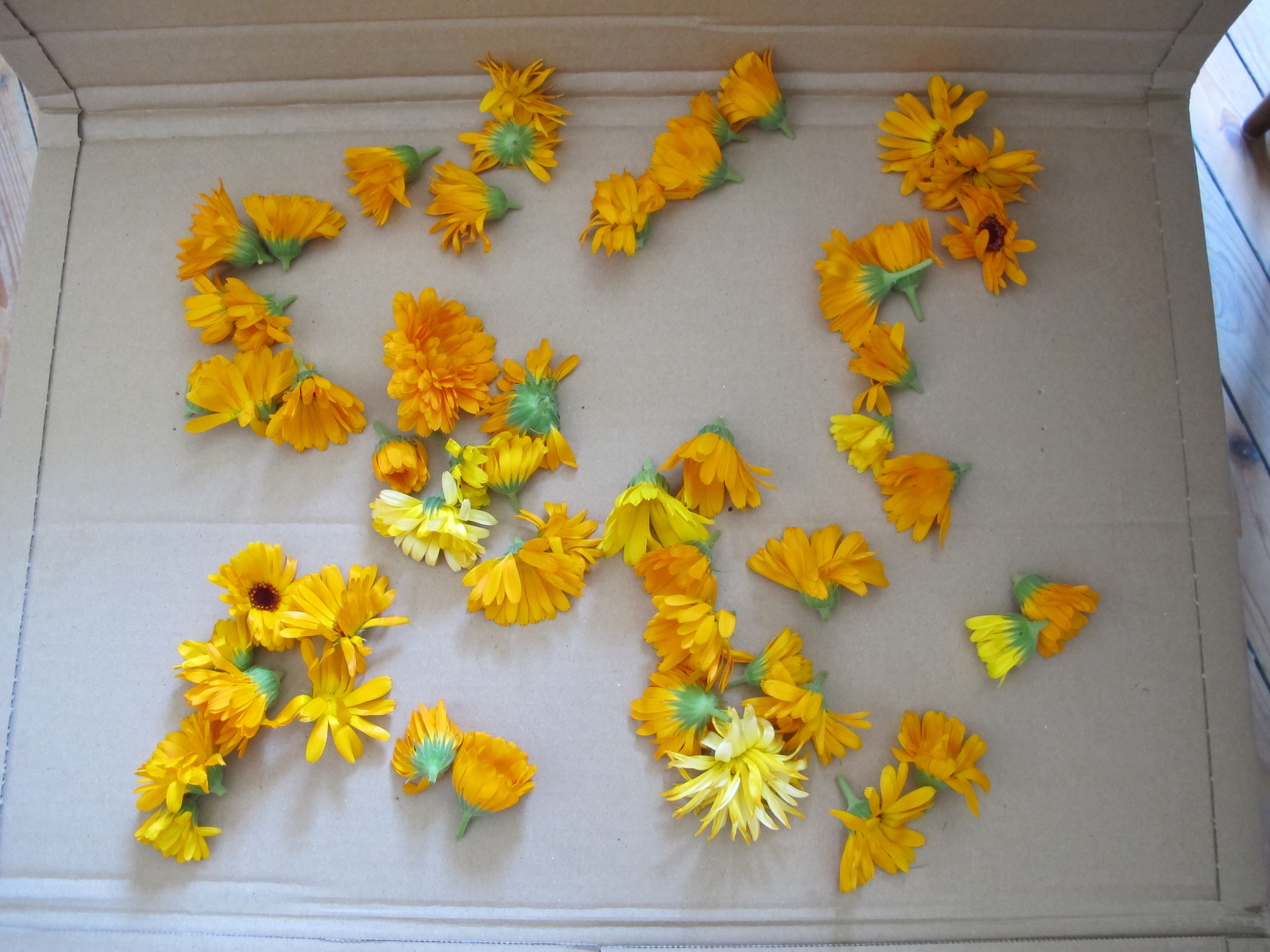
While I was there a fellow gardener mentioned that she had made her own calendula handcream with petals infused in butterschmalz (Austrian ghee). Once I got home I looked up some more information about processing calendula and laid out the flower heads on cardboard and took them up to the communal attic space to dry out.

Calendula flowerheads on cardboard.
drying calendula (ringelblumen) to eventually be used to make an infused oil

Then I had to do something with the rest of the produce – most of it can wait for tomorrow to be cooked, but the zucchini flowers had to be used straight away. At the time it seemed that deep frying them was the best way to go. However, I have never properly deepfried anything – but I do have a multicooker-rice and yoghurt making machine that also functions as a deep fryer.

Deep frying four zucchini flowers seemed like a waste of time, energy, batter and oil. so in addition to making batter and a feta and zucchini butter filling for the zucchini flowers, I found a green pepper, some sweet potato and decided to fry up some of the nasturtiums and calendula blossoms too.

tempura fried vegetables and flowers
filled Hafengarten zucchini blossoms, sweet potato, calendula flowers (not shown – green pepper and nasturtiums)

It turns out that the actual deep frying wasn’t so scary – but there is a lot to clean up. The biggest problem was that experimental cooking when you are at home alone also eventuates in solo eating. Making tempura is not so difficult, but the next time I will make sure someone else is around to help me eat it all.

Treasure

Textil Müller Treasure.

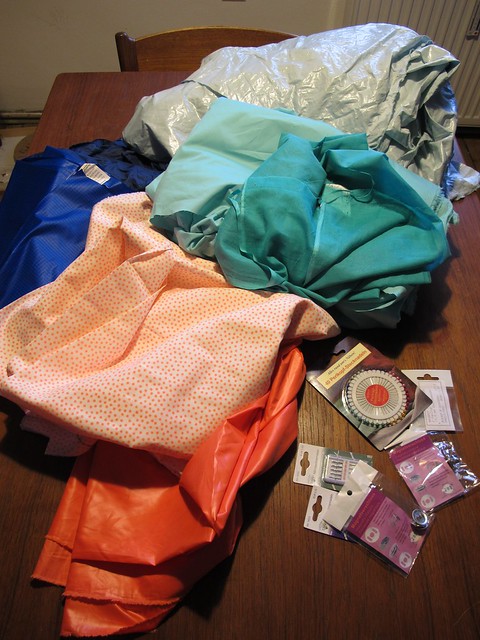
I finally got my favourite sewing machine, a vintage Husqvarna Viking 2000 – 6440, repaired and it only cost €50. I’d been putting it off sending it to the mechanic for over 2 years. So I went out and celebrated by visiting Textil Müller in Wels. I’m pretty sure that 90% of the fabric in stock was there when I last visited in 2012.

Second Ferment Kombucha

Lively Second Ferment Kombucha

A couple of years ago I unsuccessfully tried to clone a scoby from a commercial kombucha (Carpe Diem) that turned out to be pasteurised. Recently I attempted it again with an expensive bottle of very hippyish looking kombucha and was finally successful.

Since then I’ve made three batches of kombucha, each of which has been secondary fermented with dried and fresh fruit to add flavour and carbonation. This latest bottling coincided with some pretty warm weather and some very, very fizzy bottles which had to have the excess gas released to prevent explosion!